

Vaginal discharge is usually a healthy, natural part of having a vagina. It is commonly clear, white or creamy and may change from sticky to slippery throughout the menstrual cycle.
The amount varies from person to person, and your own pattern can change at different stages of life.
A new unpleasant smell, itching, burning, pain, unusual colour or unexpected bleeding may be a sign that something needs checking.
Key takeaways
- Clear, white or creamy discharge is often completely normal.
- Discharge can become wetter, clearer and more slippery as ovulation approaches.
- There is no single correct amount of vaginal discharge.
- Colour alone cannot diagnose thrush, bacterial vaginosis or an STI.
- A new unpleasant smell, itching, irritation, pain, unexpected bleeding or a persistent change from your usual discharge is worth getting checked.
- The vagina does not need to be cleaned internally or douched.
On this page
- What is vaginal discharge?
- What does normal vaginal discharge look like?
- How does discharge change during your menstrual cycle?
- What can discharge colour and texture mean?
- Is arousal fluid the same as discharge?
- Can pregnancy, contraception and menopause change discharge?
- When should you see a doctor about discharge?
- How can you care for your vulva and vagina?
- How can you keep track of changes?
What is vaginal discharge?
Vaginal discharge is a mixture of fluid, mucus, cells and bacteria from the vagina and cervix.
It's a normal part of vaginal health. Discharge helps keep the vulva and vagina moist and is part of the vagina's natural environment.
You might notice it in your underwear, on toilet paper or simply as a feeling of moisture.
The amount, appearance and texture vary between people and can change from day to day.
What does normal vaginal discharge look like?
Typical vaginal discharge is usually clear, white or creamy.
It can be:
- watery
- sticky
- creamy
- slippery
- stretchy
Normal discharge generally doesn't have a strong or unpleasant smell.
There is no single amount that's considered right for everybody. Some people notice discharge most days while others notice relatively little.
The most useful comparison is often what's normal for you.
If your discharge changes noticeably and the change comes with itching, burning, pain, irritation or an unpleasant smell, it's worth getting checked.
Colour and texture alone can't tell you whether you have an infection.
How does discharge change during your menstrual cycle?
Hormonal changes affect cervical mucus and vaginal discharge throughout the menstrual cycle.
The pattern below is common, but it isn't a fixed schedule. Ovulation doesn't happen on day 14 for everyone and not every cycle includes ovulation.
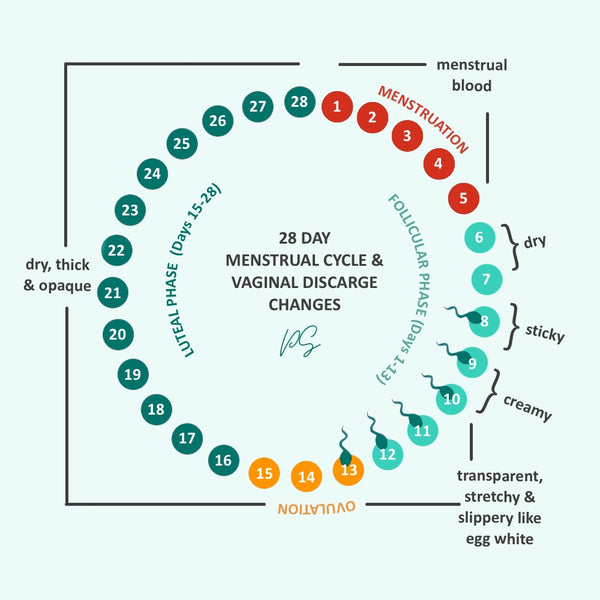
This illustration uses a simplified 28-day cycle with ovulation around day 14. Real cycles vary, and the follicular phase begins on the first day of menstruation rather than after bleeding finishes.
During and just after your period
During your period, menstrual blood mixes with cervical mucus, vaginal fluid and tissue from the uterine lining.
After bleeding finishes, you might notice very little discharge or it may be thicker, sticky or creamy.
Before and around ovulation
As oestrogen rises before ovulation, cervical mucus often becomes wetter, clearer, stretchier and more slippery.
It's sometimes described as having a consistency similar to raw egg white.
This type of cervical mucus helps sperm move through the cervix and is associated with the more fertile part of the menstrual cycle.
However, discharge changes can't tell you exactly when ovulation has occurred and shouldn't be used on their own to decide when pregnancy is or isn't possible.
Read more about the ovulatory phase.
After ovulation and before your next period
After ovulation, progesterone becomes more prominent and cervical mucus often becomes thicker, stickier or less noticeable.
Some people continue to notice creamy or white discharge throughout this part of their cycle.
Your pattern may be different if you use hormonal contraception, have irregular cycles or don't ovulate every cycle.
For more detail, read our guide to the menstrual cycle.
What can discharge colour and texture mean?
Discharge colour and texture can offer clues, but they can't diagnose an infection.
It's more useful to look at colour alongside smell, itching, irritation, pain, bleeding and whether the change is unusual for you.
| Appearance | What it may mean |
|---|---|
| Clear, white or creamy | Common and often normal, particularly when there is no itching, pain or unpleasant smell. |
| Clear, stretchy and slippery | Often associated with cervical mucus around ovulation. |
| Thick, white and clumpy | Can occur with vaginal thrush, particularly when accompanied by itching, burning or irritation. |
| Thin, white or grey with a fishy smell | Can occur with bacterial vaginosis. |
| Yellow, green or frothy | Can occur with infection, including some sexually transmitted infections. Medical assessment and testing are recommended. |
| Pink, red or brown | May be blood mixed with discharge. This can happen around a period, but unexpected bleeding between periods, after sex or after menopause should be assessed. |
Several different infections can cause similar-looking discharge, and some infections cause few or no symptoms at all.
Testing is much more reliable than trying to diagnose yourself from colour, smell or texture. For a broader explanation of infections, irritation and hormonal changes that can cause vaginal symptoms, read our guide to the causes of vaginitis.
For more about blood and spotting, read what period blood colour can mean and our guide to bleeding between periods.
Is arousal fluid the same as vaginal discharge?
Not exactly.
Sexual arousal can increase vaginal lubrication, which is often clear and slippery. Cervical mucus, on the other hand, changes throughout the menstrual cycle whether or not you're sexually aroused.
The two can look and feel very similar, so it isn't always possible to tell them apart by appearance alone.
The amount of arousal lubrication also varies between people and from one occasion to another.
Being very wet doesn't necessarily mean you're ovulating, and producing less lubrication doesn't mean you aren't aroused or interested in sex.
Physical lubrication also isn't the same thing as consent.
Can pregnancy, contraception and menopause change discharge?
Yes. Hormone changes at different stages of life can affect both the amount and appearance of vaginal discharge.
Pregnancy
It's common to notice more vaginal discharge during pregnancy.
Normal pregnancy discharge is generally clear or milky white and shouldn't have a strong unpleasant smell.
Speak with your doctor or midwife if discharge develops an unpleasant smell, unusual colour or is accompanied by itching, soreness or pain.
Contact your doctor, midwife or maternity care provider if you have vaginal bleeding at any stage of pregnancy.
If you notice a constant trickle or gush of watery fluid, particularly later in pregnancy, contact your maternity care provider because it may be amniotic fluid rather than ordinary vaginal discharge.
If the fluid is green, brown or blood-coloured, seek advice urgently.
Hormonal contraception
Hormonal contraception can change cervical mucus and your usual discharge pattern.
Some methods deliberately thicken cervical mucus as part of the way they prevent pregnancy.
See our guide to contraception options in Australia for more information about how different methods work.
Perimenopause and menopause
As oestrogen levels fall around and after menopause, many people notice less vaginal discharge and more dryness or irritation.
New or unusual discharge after menopause is worth mentioning to your doctor, and any vaginal bleeding after menopause should always be assessed.
Read more in our guide to vaginal health in perimenopause.
When should you see a doctor about vaginal discharge?
Arrange an appointment with a GP or sexual health clinician if your discharge changes noticeably from your usual pattern and the change persists.
It's also worth getting checked if you notice:
- a new strong, fishy or unpleasant smell
- yellow, green, grey or frothy discharge
- thick white or clumpy discharge with itching or irritation
- itching, burning, swelling or vulval irritation
- genital sores or blisters
- pain during sex
- pain or burning when passing urine
- lower abdominal or pelvic pain
- fever
- bleeding between periods
- bleeding during or after sex
- any vaginal bleeding after menopause
- possible exposure to an STI
Some STIs have few or no symptoms, so testing can also be worthwhile after a possible exposure even if your discharge hasn't changed.
Unusual discharge accompanied by lower abdominal or pelvic pain, fever or unexpected bleeding can sometimes be associated with an infection affecting the upper reproductive tract. Our guide to pelvic inflammatory disease (PID) symptoms explains what to look out for and why prompt medical assessment matters.
Seek urgent medical care if you have severe pelvic or lower abdominal pain, feel faint or seriously unwell or have fever with significant pelvic pain.
Call triple zero (000) in an emergency. If you're unsure how urgently you need care, healthdirect provides 24-hour advice on 1800 022 222.
If you're pregnant, contact your doctor, midwife or maternity care provider about bleeding or suspected leaking of amniotic fluid.
What happens at an appointment?
Your healthcare professional will usually ask about your symptoms, how long the change has been present, your menstrual cycle and whether there is any possibility of an STI or pregnancy.
Depending on your symptoms, they may suggest an examination, vaginal swab or STI testing.
A self-collected swab may be an option for some tests. You can also ask for a support person to be present during an examination.
If talking about intimate symptoms feels awkward, our guide to talking to a doctor about vaginal concerns may help.
How can you care for your vulva and vagina?
The vagina doesn't need to be washed or cleaned internally.
Douching, scented washes, vaginal deodorants and other fragranced products can irritate the area or disturb the vaginal environment.
A few simple habits may help reduce irritation:
- Wash the vulva gently with water. If you use a cleanser, choose a mild, fragrance-free product and use it externally only.
- Avoid perfumed wipes, sprays, deodorants and internal cleansing products.
- Choose breathable underwear if that feels more comfortable for you.
- Change out of wet swimwear or sweaty exercise clothes reasonably soon.
- Wipe from front to back after using the toilet.
- Use condoms to help reduce the risk of many STIs and consider regular STI testing when appropriate.
- If pads, liners or other products irritate your skin, try a different material or product.
If you'd prefer a reusable option for light discharge or spotting, you can browse our cloth pads and liners.
You don't need to use a product to stop normal discharge or make your vagina “cleaner”.
Should you treat discharge yourself?
Not every change in discharge is thrush.
Thrush, bacterial vaginosis, STIs and irritation can cause overlapping symptoms, so treating yourself based on appearance alone can mean using the wrong treatment.
Ask a pharmacist or doctor for advice if you're unsure, particularly if this is the first time you've had symptoms, symptoms keep returning or you're pregnant.
How can you keep track of changes?
If you're learning what's typical for your body, you can briefly record:
- the date
- colour and texture
- whether there is an unusual smell
- itching, burning or discomfort
- bleeding
- where you are in your menstrual cycle
- whether you're using hormonal contraception
You don't need to inspect or track discharge every day. The aim is simply to recognise your own pattern and notice meaningful changes.
Period Shop's free downloadable period tracker can help you record your cycle and symptoms.
Tracking can provide useful information for you and your healthcare professional, but it can't diagnose an infection or confirm that ovulation has occurred.
The main takeaway
Vaginal discharge is a normal part of vaginal health and often changes naturally throughout the menstrual cycle.
Clear, white, creamy, sticky, watery, stretchy or slippery discharge can all be normal depending on what's usual for you and where you are in your cycle.
A persistent change accompanied by an unpleasant smell, irritation, pain, unusual colour or unexpected bleeding is worth checking rather than trying to diagnose from appearance alone.
You don't need to monitor every change. Getting to know your usual pattern is enough to help you recognise when something feels different.
Related reading
- The menstrual cycle: phases, ovulation and what's typical
- Is my vagina normal? Myths, facts and essential information
- Vaginismus: symptoms, causes and treatments
- Is douching healthy for your vagina?
- What does the colour of your period blood mean?
Sources and further reading
- healthdirect: Vaginal discharge
- healthdirect: Bacterial vaginosis
- healthdirect: Vaginal and groin irritation and infection
- Pregnancy, Birth and Baby: Bleeding during pregnancy
- Pregnancy, Birth and Baby: Waters breaking
This article provides general health information and isn't a substitute for individual medical advice.